Aurora from Scotland: Why Northern UK Skies See More Geomagnetic Storms
Ask anyone who has watched the northern lights from Britain where they were standing, and the answer is almost always somewhere north of Inverness. That is not sentimentality. Scotland genuinely sits closer to the auroral oval than England or Wales, and the reason is not simply that it is further up the map. The Earth's magnetic field leans, the oval it produces is off-centre, and the way the field lines dive into the ground above Scotland shapes what you can actually see. Understanding that tilt tells you which nights are worth the drive and which are not.
Latitude is only half the story
Geographic latitude is what a paper map shows. Geomagnetic latitude is what the aurora cares about, and the two do not line up.
The north magnetic pole that a compass points to is a wandering thing, currently drifting across the Arctic toward Siberia. The pole that matters for aurora is the geomagnetic pole, the axis of the great dipole that Earth's field roughly resembles. It sits over northern Canada, near Ellesmere Island, and it has barely moved in decades. Because that axis is tilted by about ten degrees from the planet's spin axis, the auroral oval is not a neat ring around the North Pole. It is squashed, pushed south over North America and lifted north over Siberia.
The practical result is that two places at identical geographic latitude can be five degrees apart in geomagnetic terms. Roughly speaking, Shetland sits at about 62 degrees geomagnetic latitude, Edinburgh around 58, and London somewhere near 53. The quiet-time auroral oval hovers around 66 to 67 degrees geomagnetic latitude. So Scotland is not just a little closer to the lights. It is on the doorstep of the oval's southern rim on nights when the rest of Britain is hundreds of kilometres away. St Petersburg, sitting at almost exactly Lerwick's geographic latitude, is several degrees further from the oval.
Put another way, Lerwick and St Petersburg share a parallel on the globe, but they do not share an aurora forecast. The same distortion that lifts the oval over Siberia drops it over Canada, which is why Winnipeg sees the lights more often than Paris at a comparable latitude. Scotland gets a smaller but still real version of that geomagnetic advantage.
What geomagnetic inclination actually does
Inclination, also called magnetic dip, is the angle at which the local magnetic field meets the horizontal. At the magnetic equator the field runs flat, parallel to the ground. At the poles it points straight down. In Scotland the field lines plunge into the earth at something close to 70 degrees; in southern England it is a few degrees shallower.
Charged particles from the solar wind spiral along those field lines. Where the lines enter the atmosphere at a steep angle, the particles arrive almost vertically and are funnelled into a narrow footprint. That is why the aurora forms a band rather than a smear.
Inclination does not cause aurora by itself. It is a marker of how close you are to the auroral zone, and it changes what the display looks like from the ground. It also explains why the aurora tends to appear at a fairly consistent altitude, mostly between 100 and 300 kilometres up, where incoming particles collide with oxygen and nitrogen. Green light usually comes from oxygen around 100 to 150 kilometres; red fringes come from higher, thinner oxygen. From Scotland, both colours can appear in the same curtain.
Why Scottish displays look like tall curtains
From most of Scotland you are looking at the oval from the side, not from underneath it. The glow is a hundred and some kilometres up and often a few hundred kilometres north, so you see the structures edge-on. That is the classic view: long vertical rays, folded curtains, a green arc sitting low over a northern horizon. Observers directly beneath the oval tend to see a wider, softer glow spread overhead. Both are the same phenomenon, viewed from different angles.
From Scotland, you are rarely underneath the aurora. You are watching it from the stalls, side-on.
That perspective is why a modest display can still look dramatic in a photograph. A camera gathers light for seconds at a time, revealing rays and colour that the naked eye may read as a pale grey band. It is also why a north-facing horizon matters more than standing on the highest hill. You need darkness, a clear sky, and an unobstructed view toward the north.
Why the auroral oval moves
The oval is not fixed. It breathes and shifts with the solar wind, the stream of charged particles blowing off the Sun. When the wind is calm, the oval sits near its quiet-time position and Scotland is on the edge of the action. When a coronal hole or a coronal mass ejection sends a stronger gust toward Earth, the oval expands southward and Britain gets pulled into the auroral zone.
The critical detail is the direction of the interplanetary magnetic field, especially its north-south component, usually written as Bz. When Bz turns southward, the solar wind's magnetic field connects more easily with Earth's field. Energy pours into the magnetosphere, and the aurora responds. When Bz is strongly northward, the door is mostly shut, even if the solar wind is fast. This is why two nights with similar solar wind speeds can produce very different displays.
Geomagnetic storms are ranked on the same Kp scale, and severe ones can push the oval far enough south for southern England or northern France to see a glow. The great May 2024 storm, one of the strongest in two decades, produced aurora reports from across the UK and much of Europe. Those events are rare, but they show that Scotland's advantage becomes a national spectacle when the oval is stretched far enough.
There is also a seasonal quirk. Around the equinoxes in March and September, Earth's magnetic field is oriented more favourably to the solar wind, a phenomenon known as the Russell-McPherron effect. Statistically, geomagnetic storms are more common then. If you are planning a dedicated aurora trip to Scotland, the weeks around the equinoxes are worth circling.
The Kp number, translated for British observers
Forecasts quote Kp, a three-hourly index of global geomagnetic disturbance running from 0 to 9. It is a coarse, planet-wide number, not a promise about your postcode. As a rough rule of thumb for the UK:
- Kp 4 or below: nothing visible to the naked eye from almost anywhere in Britain. A long camera exposure from Shetland might catch a faint glow.
- Kp 5: Shetland, Orkney, Caithness and the north coast are in with a real chance. Possibly Aberdeenshire and the Outer Hebrides from a genuinely dark site.
- Kp 6: northern Scotland comfortably, and often down through the Central Belt and southern Scotland.
- Kp 7: a good chance across much of Britain if the sky is clear, including parts of northern England, Wales and the south-west.
- Kp 8 to 9: rare, but capable of bringing the aurora into southern England and even northern France. Light pollution and cloud are usually the bigger obstacles.
Remember that Kp is a global average. Local conditions can overperform or underperform, and a sudden substorm can brighten the sky for twenty minutes before fading again. If a forecast says Kp 5, it does not mean the whole night is active. It means the window is open.
Where to stand in Scotland
Once you accept that darkness and a northern horizon matter as much as latitude, the map becomes simple. You want to be north, away from towns, and facing open sky.
- Shetland and Orkney: the best base in the UK. Even modest activity can show here, and the islands have plenty of low-light coastal viewpoints.
- Caithness and the north coast: Dunnet Head, Thurso and the coast around Durness offer a clear northern horizon over the sea.
- Aberdeenshire and the Moray coast: good for Kp 5 and above, especially where farmland or coastline keeps the sky dark.
- The Outer Hebrides: Atlantic-facing dark skies and few large settlements, though cloud is a frequent enemy.
- The Cairngorms and Lochaber: excellent darkness inland, but mountains can block the northern horizon. Choose a loch or glen opening north.
- Galloway Forest Park: a Dark Sky Park in southern Scotland that can deliver during Kp 6 or stronger events.
Wherever you go, check the cloud forecast first. A Kp 7 night under overcast skies is worse than a Kp 5 night with a clear northern horizon.
Timing, weather, and the eye
Aurora hunting in Scotland is a patience game. The lights can appear at any time after dark, but the most common window is roughly 9pm to 2am, with a peak around local magnetic midnight. Here is a practical routine:
- Check space weather and cloud cover together. A high Kp number means little if the sky is closed.
- Find a dark, north-facing viewpoint. Avoid streetlights, car headlights and the glow of towns.
- Let your eyes adapt. Give them at least twenty minutes without white light. Use a red torch if you need one.
- Look for a pale arc or grey band. To the naked eye, aurora often starts as a milky streak low in the north, not a vivid green curtain.
- Use a camera if you have one. A steady tripod and a few seconds of exposure will confirm what your eyes suspect.
Dress for winter even in summer. Scottish aurora nights are cold, damp and long, and the best displays often reward the people who stay out after everyone else has gone home.
The quiet truth about Scottish aurora
Scotland is not Iceland or Tromsø. It does not sit directly under the auroral oval, and most nights will not produce a naked-eye display. But it is the best placed part of the UK, and on the right night the combination of geomagnetic latitude, steep field lines and a dark northern horizon turns the north of Scotland into a genuine aurora viewpoint. The trick is not to chase a guarantee. It is to understand the tilt, watch the forecasts, and be outside when the oval leans south.
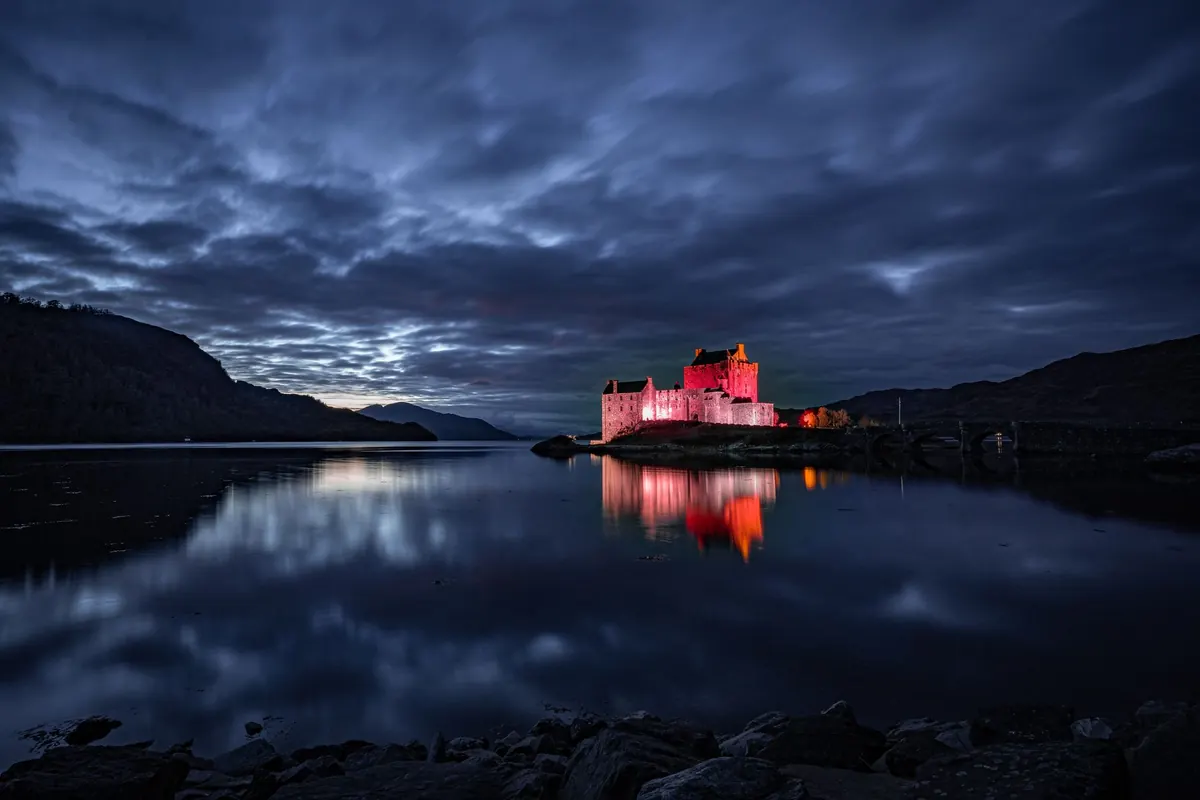
Photo: Clément Proust / Pexels