Sunspots and Solar Cycles: What Solar Cycle 25 Means for Space Weather
Every so often the Sun grows a crop of dark freckles. From roughly 150 million kilometres away they look tiny, but each one is a marker of enormous magnetic violence. A single sunspot can be larger than Earth, and the active region around it may store enough energy to power billions of nuclear explosions. When that energy is released, it can send radiation, plasma, and magnetic fields racing toward our planet. That is space weather—and Solar Cycle 25 is one of the most closely watched chapters in the modern study of it.
What Are Sunspots?
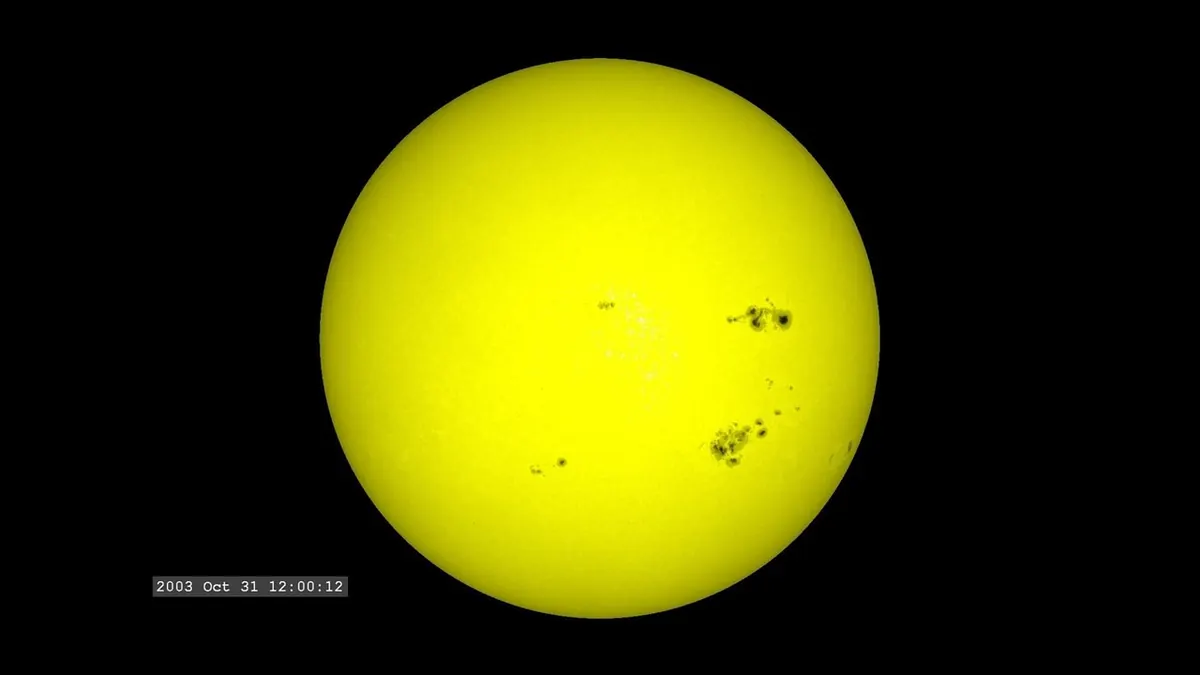
Sunspots are cooler, darker patches on the Sun’s visible surface, the photosphere. They look dark not because they are black, but because they are less bright than the surrounding solar material. A typical sunspot is around 3,800 kelvin, compared with about 5,800 kelvin for the surrounding surface. The contrast makes them stand out like ink stains on a glowing page.
The darkness is a symptom of something far more powerful: intense magnetism. Sunspots form where bundles of magnetic field punch through the photosphere from deeper inside the Sun. These fields are thousands of times stronger than Earth’s magnetic field. They suppress the rising convection of hot plasma, so the region cools and appears dark. A sunspot usually has a darker central umbra and a surrounding, more fibrous penumbra.
Sunspots are not isolated blemishes. They are the visible anchors of active regions, sprawling magnetic complexes that can produce solar flares, coronal mass ejections, and bursts of energetic particles. A sunspot group may last from a few days to several weeks. The more complex and tangled its magnetic field, the more likely it is to erupt.
The Solar Cycle: A Magnetic Heartbeat
Sunspot counts rise and fall in a rough rhythm of about 11 years. At solar minimum, weeks can pass with few or no sunspots. At solar maximum, dozens may appear at once, and the Sun’s atmosphere crackles with activity. This pattern has been recorded since 1755, when scientists began numbering the cycles. Solar Cycle 25 began in December 2019.
The 11-year cycle is only half the story. The Sun’s global magnetic field flips polarity every 11 years, so a full magnetic cycle—sometimes called the Hale cycle—takes about 22 years. During one cycle, sunspot pairs tend to have a certain magnetic orientation; during the next, that orientation reverses. The cycle also follows a “butterfly” pattern: sunspots emerge at higher latitudes early in a cycle and progressively closer to the equator as it proceeds.
The cycle is not a smooth sine wave. It rises quickly, often reaches a broad and uneven maximum, and then declines more slowly. Some cycles have double peaks. Predictions are difficult because the Sun’s interior dynamo is complex and only partly understood. Solar Cycle 25 was initially expected to be modest, similar to or slightly stronger than Solar Cycle 24. In reality, it has repeatedly exceeded many forecasts.
Solar maximum is not a single day on a calendar; it is a season of heightened activity that can last for years.
Why Solar Cycle 25 Matters for Space Weather
Space weather is the chain of effects that begins with solar activity and ends in Earth’s environment. More sunspots generally mean more active regions, and more active regions mean more chances for flares and eruptions. But quantity is not everything. A single complex sunspot group with a twisted magnetic field can produce a major storm even when the overall sunspot number is modest.
Solar Cycle 25 has already delivered significant space weather. In May 2024, a severe geomagnetic storm reached G5—the highest level on NOAA’s scale—and produced auroras visible at unusually low latitudes. It was the strongest storm in more than two decades. The cycle has also generated X-class solar flares, radio blackouts, solar radiation storms, and lesser geomagnetic disturbances. Each event is a reminder that the Sun can affect technology and infrastructure even when the cycle is not at its absolute peak.
Flares, CMEs, and Solar Energetic Particles
Solar flares are sudden bursts of radiation, especially X-rays and extreme ultraviolet light. They reach Earth in about eight minutes and can disrupt high-frequency radio communication and satellite navigation signals. Coronal mass ejections, or CMEs, are billion-ton clouds of magnetised plasma. They take anywhere from about 15 hours to several days to arrive. When a CME strikes Earth’s magnetic field, it can trigger a geomagnetic storm.
Solar energetic particles are another hazard. These high-speed protons and other charged particles can arrive within minutes to hours of an eruption. They pose a radiation risk to astronauts, high-altitude aircraft crews, and satellites. A single active region can produce all three phenomena—flare, CME, and particle event—in quick succession.
What Space Weather Can Do
The effects of space weather range from beautiful to disruptive. The same geomagnetic storm that paints the sky with auroras can also create problems for systems we rely on every day.
- Satellites and astronauts: Radiation can damage electronics, degrade solar panels, and interfere with sensors. Increased atmospheric drag during geomagnetic storms can alter satellite orbits, as happened in February 2022 when a storm contributed to the loss of dozens of Starlink satellites shortly after launch.
- Power grids: Geomagnetic storms induce electrical currents in long conductors. In March 1989, a storm caused a major blackout in Quebec. In 2003, the Halloween storms disrupted power systems and satellites.
- Navigation and communication: Ionospheric disturbances can degrade GPS accuracy and high-frequency radio. Airlines may reroute polar flights to avoid radiation and communication gaps.
- Aviation and pipelines: High-altitude crews face increased radiation exposure. Pipelines can experience induced currents that accelerate corrosion if not managed.
- Auroras: For many people, auroras are the most welcome effect. Strong storms can push the northern and southern lights toward the equator, creating unforgettable displays.
Historically, the most extreme known event was the Carrington Event of 1859. It produced auroras near the equator and sparked fires in telegraph offices. A similar storm today would test satellites, power grids, and global communications on a far larger scale.
Solar Cycle 25: Forecast Versus Reality
Solar Cycle 25 began when the Sun was near a deep minimum. Forecasters expected a relatively weak cycle, in part because Cycle 24 had been subdued. But the Sun has shown more vitality than many models suggested. Sunspot numbers, flare activity, and geomagnetic storm frequency have all run ahead of some predictions.
Whether the cycle is still climbing, near its peak, or just past it, the message is the same: the maximum is not the only time to pay attention. Major storms can occur during the declining phase, and even a modest cycle can produce a severe event. The Sun does not consult a graph before it erupts.
How to Prepare and Watch
Preparation looks different depending on who you are. For satellite operators, it means radiation-hardened components, real-time anomaly monitoring, and plans to safe modes during storms. For power grid managers, it means monitoring geomagnetic disturbances and protecting transformers. For airlines, it means flexible routing and radiation monitoring for crews. For emergency planners, it means understanding that space weather is a natural hazard with cascading technological effects.
For the public, the first step is simple awareness. Space weather agencies such as NOAA’s Space Weather Prediction Center issue forecasts, watches, and warnings. The Kp index describes geomagnetic disturbance, and the G1-to-G5 scale ranks storms. Aurora forecasts can tell skywatchers when to look up. Never look directly at the Sun without proper solar filters, but you can safely track sunspots through certified solar glasses or telescopes with solar filters.
Everyday Observers
You do not need a laboratory to follow Solar Cycle 25. Safe solar observing can reveal sunspot groups changing from day to day. Aurora alerts can turn a normal evening into a memorable one. Understanding the difference between a flare and a CME helps make sense of headlines. And knowing that a geomagnetic storm can affect GPS, radio, and power systems makes space weather feel less abstract.
The Bigger Picture
Solar Cycle 25 is a reminder that we live near a variable star. The Sun gives us light, heat, and the conditions for life, but it also throws tantrums. Its sunspots are not mere freckles; they are visible clues to a magnetic engine that shapes the space around Earth. As our dependence on satellites, navigation, communication, and electrical grids grows, so does our exposure to solar storms.
We cannot stop the Sun from erupting. We can improve forecasts, harden technology, train operators, and educate the public. Missions such as Parker Solar Probe, Solar Orbiter, and the Solar Dynamics Observatory are helping scientists understand the solar dynamo and the origins of eruptions. Every cycle adds data, and every storm adds urgency. Solar Cycle 25 is not just an astronomy story; it is a test of how well modern society can read the weather report from 150 million kilometres away.
Photo: WikiImages / Pixabay